
From Concept to Casting: OEM Jewelry Development
Between a concept sketch and a cast piece sit five stations a buyer never sees: hand drawing, CAD, prototyping, sprue cutting and the first inspection. The published OEM/ODM development clocks wrap around them — CAD work takes 48 hours (CAD) / 25–30 days (sample) / 3–4 weeks (run) (run) (run) — CAD, sample, run (run) go to the first production run — and three compliance statements travel with the order from the first casting onward.
Key takeaways
- Concept design starts as a hand drawing and is then built as 3D CAD for dimensional approval.
- Prototyping runs either through a mould or through 3D printing, depending on the design and quantity.
- Sprue cutting follows casting, and polishing and surface art run before any plating is applied.
- Three published compliance items cover it: An audited BSCI social-compliance programme, ISO 9001:2015 certification and REACH restrictions on lead, cadmium and nickel.
Concept design: hand drawing first, CAD second
The first factory step is not a machine. It is a sketch, then a 3D drawing made from it. Working by hand first is not nostalgia — it is faster to redraw a curve on paper than to rebuild a CAD model, so proportions get settled cheaply before anything digital is committed.
The CAD file that follows is the document the whole order is measured against, and it comes back inside 48 hours with realistic renderings so the piece can be judged at size long before metal exists.
Prototyping: mould and 3D printing compared
Prototyping has two published routes. A mould is the right choice when the piece will be repeated and the quantity justifies the tool, because the mould survives the sample and goes into production. A 3D-printed prototype is the right choice when the shape is still being judged, because it can be produced straight from the CAD file without committing to tooling.
In practice most first orders use both: a printed model to confirm the concept, then a precision mould for the sample that will be duplicated.
Sprue cutting and the first inspection point
When a piece comes out of the mould it is attached to a runner of metal, the sprue, that has to be cut away and the joint dressed back to the surface. This is a rough-finished stage, and it is where a casting that came out off-round gets caught rather than carrying the fault into plating.
Ask who inspects at this point. A factory that only inspects at the end is checking the result of every previous stage at once, with no way to tell which one failed.
Polishing and surface art before the tank
Polishing produces the high-gloss finish, and surface art adds the brushed or textured areas that sit alongside it. Both happen before electroplating, because a mirror finish under plating and a brushed finish under plating are two different looks, and neither can be recovered once the metal has been coated.
The plating build: multi-layer gold in 14K, 18K and 24K, a rhodium layer, an anti-tarnish e-coat applied to silver and brass and stainless steel finished with PVD vacuum plating.
The paperwork that travels with a casting
A finished casting carries claims, and claims are checkable documents. Three published items cover most of what a retail partner will ask about in a supplier audit, and all three are statements about the process rather than about a single batch of metal.
| Item | What it covers | Who asks for it |
|---|---|---|
| ISO 9001:2015 | Quality management across all production stages | Brands running supplier audits |
| BSCI audit | Labour conditions, safety and supply chain ethics | Retail chains and marketplaces |
| REACH compliance | Materials free from lead, cadmium and nickel | EU importers and compliance teams |
Note what these do not say. None of them promises that every piece is identical, and none replaces the 100% inspection step before delivery. They tell you what to ask for when a claim is made: the certificate number, the audit date and the restriction list behind the materials statement.
Worked example: five compliance checks behind one order
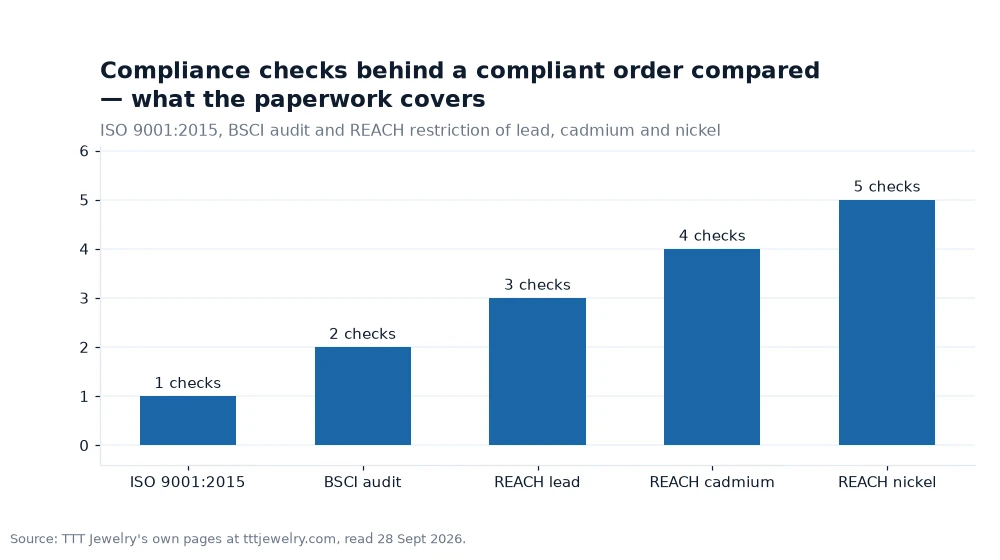
Count the published items on a single order and the list runs to five lines. Number them: A BSCI audit, ISO 9001:2015 certification and REACH restrictions on lead, cadmium and nickel, cadmium fourth and nickel fifth. So one order carries five checks, of which three are material restrictions under a single regulation.
Put differently, the metals restriction side of that list is 3 ÷ 5 = 60% of the paperwork a compliance team is likely to read first. The counting and the division are mine; the compliance items themselves are published.
Where development ends and production begins
The boundary is the approved sample. Up to that point every stage is negotiable, because a change costs drawing time or a fresh wax print. After it, the order is a repeat of something already proven: same tooling, same finish, same inspection points, more pieces.
That is the argument for putting the design argument early. A custom OEM jewelry factory will absorb a concept change during the consultation for the price of a conversation; the same change after casting means new tooling and a second sample window.
What a buyer should keep after delivery
Three things are worth filing: the approved CAD drawing, the sample itself and the batch inspection record. Together they let you compare a second production run against the first, and they are what a reorder is quoted from.
A reorder without the drawing in hand is a new project with a new feasibility check, which is a slow way to buy something you already own.
Frequently asked questions
Does every design need a mould?
Not immediately. 3D printing covers the concept stage without committing to tooling, and the mould is cut when the shape is settled and the quantity supports it.
Who decides between a mould and a printed prototype?
It is a joint decision made during consultation and development, where base material, quantity and cost structure are weighed before the CAD file is drawn.
Are the compliance statements part of the delivery documents?
They are published as standing statements rather than per-order certificates, so it is reasonable to ask for the certificate number and the audit date alongside the batch inspection record.
Debugging a design before the mould is cut
Most quality problems are decided, not discovered: the wall thickness at concept stage, the stone seat at drawing stage, the surface finish before plating. Each one is cheap to fix at the station where it was created and expensive to fix at delivery.
That is why the first two steps matter more than they look. Buyers who spend an hour with the drawing and a day with the sample usually skip the stage where refunds happen. If the first range is a plated one, the eco-brass line shows how surface art and plating interact, and the 925 silver line shows the same sequence with an anti-tarnish coat on top.
Tracked back — the 100% NDA terms, the master-sample benchmark and the full-inspection rule — every one of them came from the manufacturer's own website on tttjewelry.com, which I went through on 28 Sept 2026. The derived numbers rather than the published ones are my own arithmetic rather than the manufacturer's[1].